Gas explosion accidents are frequent, in accordance with the requirements of the "Safety production Law of the People's Republic of China", gas alarm installation is imperative
2021.06.13 page view:204Nowadays, gas has entered thousands of households, and the use of gas is convenient and clean, which brings convenience to life. However, in the process of use, accidents such as explosions and poisoning caused by gas leaks occur from time to time, which seriously threaten the lives and property safety of the masses of people.
nce the gas is inhaled by the human body, it will reduce the oxygen carrying capacity of red blood cells, resulting in tissue suffocation, resulting in fainting, paralysis, suffocation and other personal injuries; When it reaches a certain concentration, it is easy to explode and cause serious safety accidents such as fire. The most serious accident in gas accidents is gas explosion, and gas leakage or abnormal escape is the main cause of gas explosion.
Gas stoves, gas water heaters and other equipment are many rubber hoses are directly connected to the gas meter outlet valve, a long time the hose may be due to smoke erosion, aging, rat bite and other reasons for leakage risk. This leakage is sometimes slow and unnoticeable, and sometimes it is not a quick response. Manual identification alone, the error is large, can not ensure real-time discovery.

The role of the gas alarm
Despite a lot of work has been done, accidental leakage of gas is still difficult to avoid. In this way, some early warning measures are needed to remind users that adding odor agents to gas plays the role of people's olfactory organs; Gas leak alarm sound and light alarm function to play the role of human hearing organs and visual organs; These measures will give full play to the role of people's sensory organs and mobilize, through the implementation of comprehensive early warning of gas leakage information to find gas leakage in time to avoid the occurrence of accidents caused by long-term gas leakage.
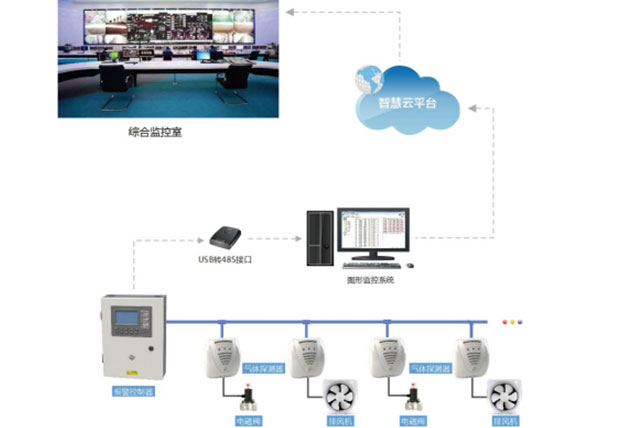
The gas alarm is actually a detector that detects the concentration of gas, and its core component is a sensor. The gas alarm should be installed in the place where gas leakage may occur, when the concentration of gas in the air exceeds the set value, the detector will be triggered by the alarm, and the external sound and light alarm signal. If the alarm is connected to the alarm host and the alarm center, it can be connected to the alarm, and it can automatically start the exhaust equipment, close the gas pipeline valve, etc., to prevent the gas from continuing to leak and ensure the safety of life and property.

Is it necessary to install gas alarm?
For the safety of yourself and your family, it is necessary to install a gas alarm.
Household gas alarm is a small and beautiful gas safety product suitable for family use, simple principle and convenient installation.
The core of the gas alarm is the gas sensor, commonly known as the "electronic nose". This is a unique resistor, and when "smelling" gas, the sensor resistance changes with the gas concentration. When the gas reaches a certain concentration and the resistance reaches a certain level, the alarm will issue an audible and visual alarm to remind people that a gas leak has occurred. Some alarms can also be linked with the electromagnetic cut-off valve, which can automatically close the gas valve when the alarm is generated to prevent the gas from continuing to leak. Therefore, the gas alarm is basically "ready at home".
If there are elderly people or children in the home, it is recommended to install one, because the elderly sometimes forget, and children are curious about the unknown world at the moment, these two groups are not sensitive to the smell of gas leaks, but also vulnerable groups.
In civil safety prevention projects, it is mostly used for household gas leak alarm, and is also widely used in various types of refineries, oil depots, chemical plants, liquefied gas stations and other places prone to flammable gas leakage.
How to choose a gas alarm?
Choose the gas alarm, do not only look at the price, but also see whether the product has the fire certification, that is, you can check the flow of the product on the fire network, can be used at any time for relevant inspectors to see, to ensure the quality of the instrument.
Now there are many inexpensive, unapproved products on the market, most of which will produce false positives and do not transmit signals after a period of use. So you need to choose the right gas alarm.
How to install a gas alarm?
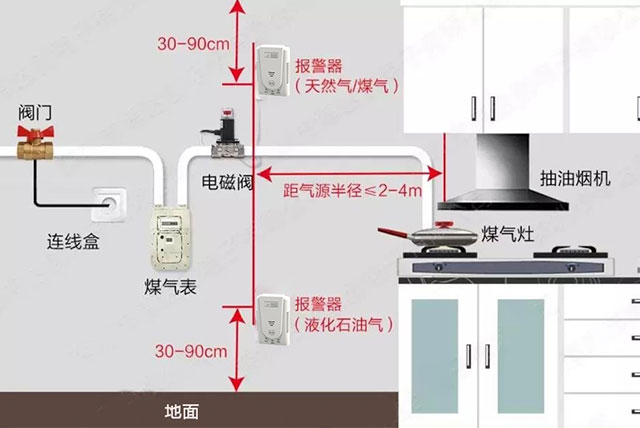
1, installed at a distance of 0.3-1.2m from the household ceiling, within 1.5M of the air source radius.
2, mark the location of the installation hole on the wall, drill and use screws to fix, if there is no drilling tool, you can also use strong double-sided tape to fix the installation.
3, after fixed installation, connect the power cable and gas emergency cut off the solenoid valve connection line, complete the installation.
Note:
1, when choosing the installation position, first check whether there is a strong electromagnetic field around (such as: high-power motors, transformers, etc.), so as to avoid the alarm being affected by a strong magnetic field when working.
2, the gas alarm when the sound and light display, the installation is best to choose a position that is easy to see and hear, once the alarm, can be found and processed in the first time.
3, do not install in high temperature, high humidity environment, so as not to affect the detection accuracy of the alarm. In case of failure, please contact professional maintenance, do not disassemble the gas alarm.
If you need to install a gas alarm, it is best to ask professionals to carry out construction, and usually pay attention to regularly detect the gas alarm to avoid the gas alarm losing its role and causing hidden dangers to the safety of the family.

First, the relevant standards for the setting of household gas leak alarm provisions
1. 2021 Production Safety Law of the People's Republic of China
The production and operation units that use gas in catering and other industries are required to install combustible gas alarm devices and ensure their normal use. For particularly serious accidents, the maximum fine can reach 100 million yuan.
2.CECS-2014 Technical Guidelines for Building Gas Safety Application
5.5.5 Gas users of high-rise residential construction should choose gas leakage monitoring and cut-off gas meters.
7.1.2 Gas users of multi-storey residential buildings should set a single-household gas leak alarm.
High-rise residential buildings and industrial and commercial building gas users should set up gas leakage centralized alarm control system.
3.GB50494-2009 "Urban Gas Technical Specifications"
8· 1.2 When the fuel appliance and gas equipment are installed in the basement, semi-basement and poorly ventilated places, ventilation, gas leakage alarm and other safety facilities should be set up.
4.GB50028-2006 "Urban Gas Design Code"
10.4 Household gas use
10.4.3 Exhaust fans and combustible gas alarms should be installed in the kitchen of residential buildings.
10.4.4.5 When the kitchen is a dark kitchen on the ground (without direct outdoor doors and Windows), in addition to the gas stove with automatic flameout protection device, gas concentration alarm and mechanical ventilation equipment should be set up.
5. Urban gas construction specifications
3.4 Gas use and gas equipment 3.4.3 When the fuel and gas equipment are installed in the basement, semi-basement and poorly ventilated places, ventilation and gas leakage alarm system and other safety facilities should be set up.
7.1 Residential fuel appliances and accessories 7.1.6 High-rise buildings and open kitchens should be equipped with ventilation, gas leakage alarm system and other safety facilities.
6.CJJ51-2006 "Urban Gas Facilities Operation, maintenance and emergency repair safety Technical Regulations"
3.5.7 Urban gas supply units shall publicize the use of combustible gas concentration alarms to users.